In the late morning, as I entered the stairway leading down to Jordan Station in TST for the first time, my first impression was that the flow of people was much less orderly than in Taiwan. I fought against this disorderly flow for a moment or two, until I remembered that the the left-right conventions are flipped here. A reminder that one’s initial judgements of a place should be tempered with some amount of humility—I was the one creating disorder for lack of understanding.
I also realized cash is surprisingly dominant here, as it was in Taiwan. Cash is required for purchasing an Octopus card at the service center in the station. The Octopus card seems to be the equivalent of the Easy Card I used in Taiwan—it is a widely accepted (and often preferred) form of payment. As far as I know, no US city has a comparable kind of system.
I still hear quite a bit of Mandarin around me, despite Cantonese being the dominant language. However, I notice that many spoken announcements are provided in Cantonese, English, and Mandarin—e.g. my hotel’s elevator, transit announcements.
After a quick bánh mì for lunch, which I ate while walking—not so pleasant due to the (pedestrian) congestion in Central (I couldn’t find anywhere pleasant to sit), I went to Hong Kong Park.
When I arrived at a corner just opposite the park, I realized there was no way to cross. Instead, I observed people making their way to the park from my side via a pedestrian bridge just above me.
I thought I had followed the signage properly, but I had used my own instincts to fill in gaps in the sign continuity and erred at some point.
Multiple times, I then followed signs promising arrival at Hong Kong park, and each set of escalators seemed to send me anywhere but the park.
In theory, I can appreciate the efficiency of these multilevel pathways, but for a first-timer (who, admittedly, needs greater-than-average navigational hand-holding), the signs are not sufficient.
Yet there seemed to be an abundance of sign-budget for signs of the particularly useless variety.
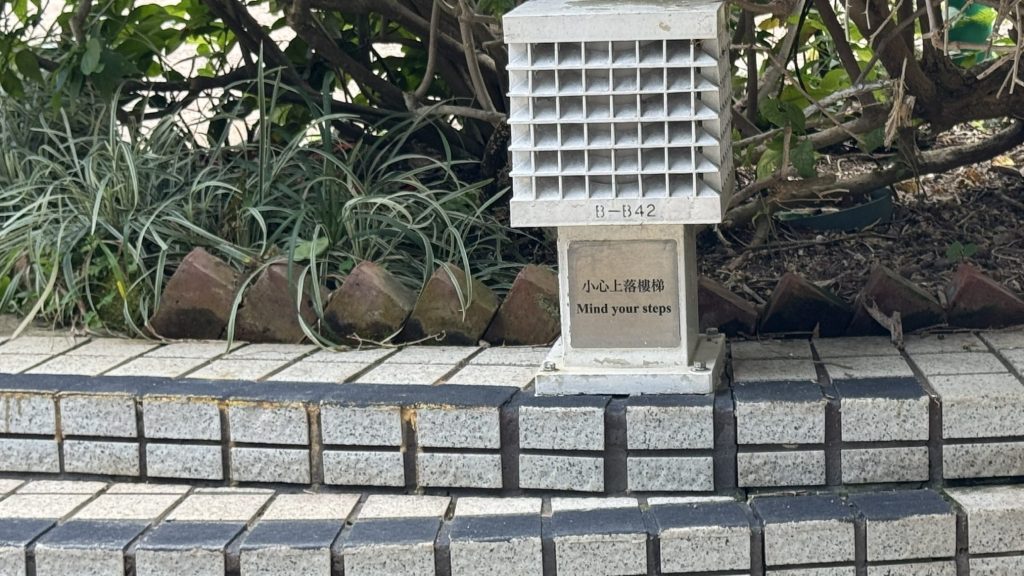
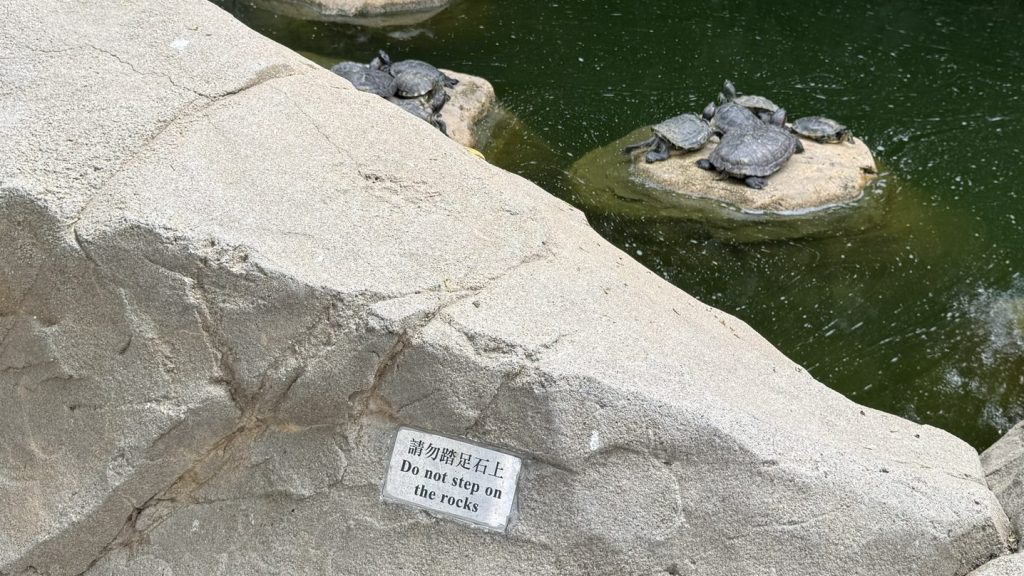
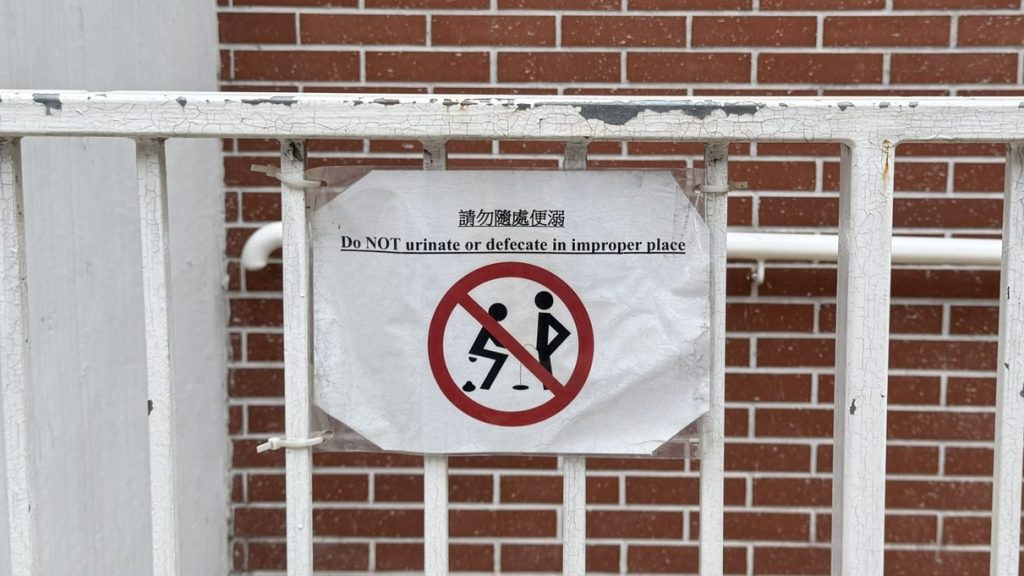
Many signs are of the variety “don’t do this here”.
Especially annoying were the “do not sit” ones (no pic, sorry)—why create perfectly sitable ledges and not allow sitting? A personal nightmare.
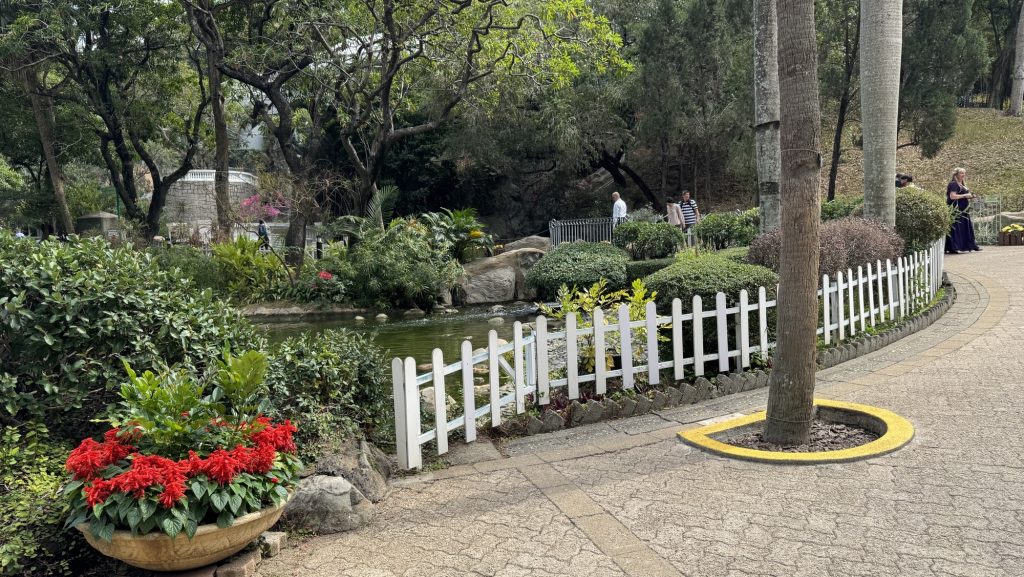
Even beyond the silly signage, I found the park disappointing. It’s overly manicured, like an outdoor mall. Surely there is some better balance between cleanliness and sterility, between polished and uninspiring.
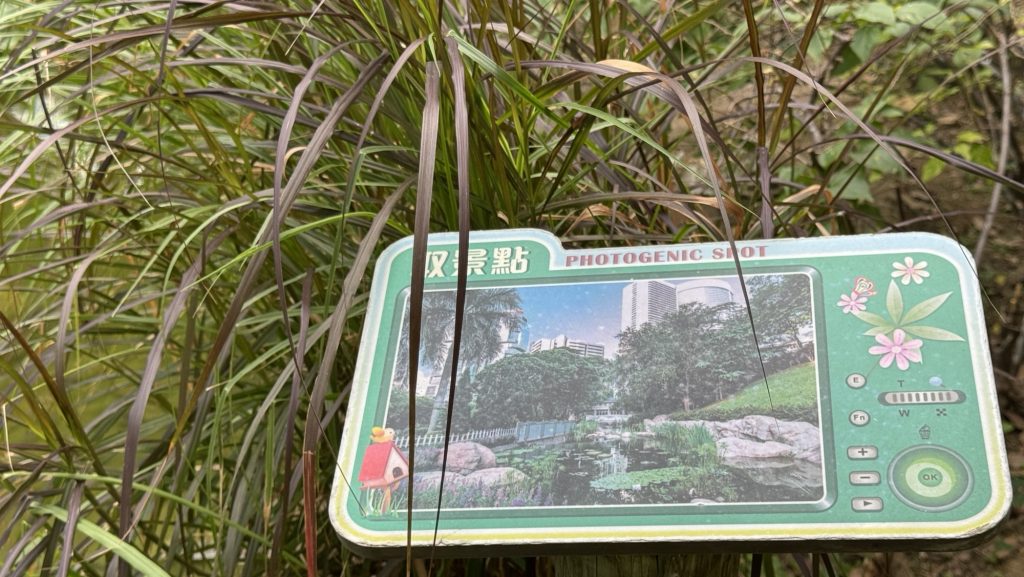
I was genuinely surprised the benches in the park did not say “do not sit”.
For a solid few minutes, I truly believed the bird sounds might be playing through speakers hidden in the trees, Rain Forest Cafe style.
All the plants looked like they had been placed there in the morning, and at the end of the day, they’d toss them to make room for the fresh batch tomorrow.
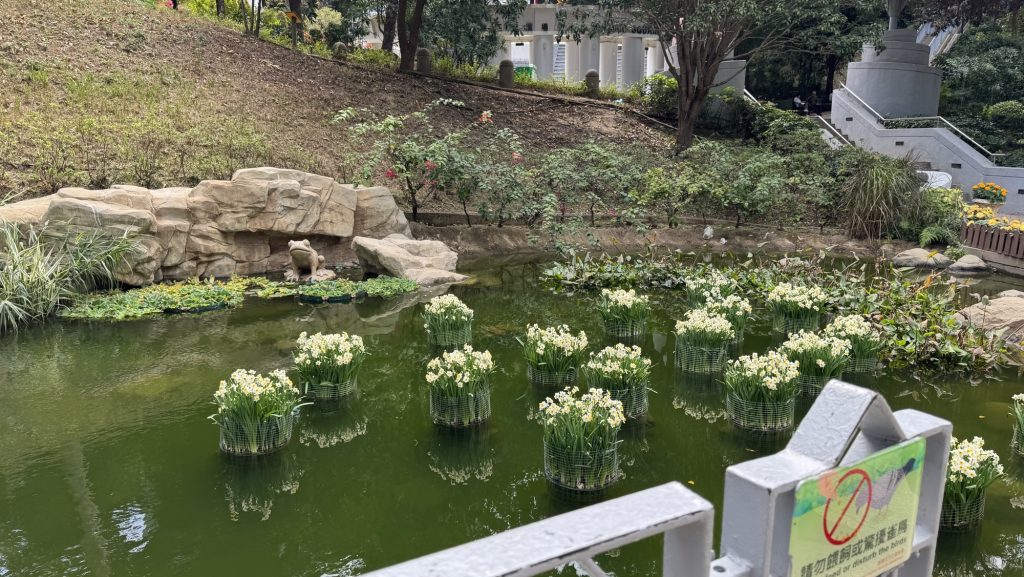
(And thank GOD the water fountain specified “for drinking only”—I was just about to clean my dirty azzole in it (Hong Kong, like the US, has yet to hear of the bidet—I was spoiled in Taiwan)).
Each tree has a name tag and a number tied around its trunk; the park’s unhappy prisoners.
Maybe it’s inevitable that progress entails turning the world into something resembling a museum…
In witnessing my own internal commentary during this park visit, I was aware that these judgments, more than anything else, betrayed a brain that was overwhelmed, tired, and (consequently) a tad cynical. And maybe Hong Kong’s hyper-capitalism isn’t my vibe—yet I somehow miss my (hyper-capitalist) home.
I decided to head back to the hotel to nap; I only hoped the couple in the adjacent room got all their loud sex out of their system the night before (I had considered banging on the paper-thin wall, but the optimal game-theoretic response would be to ignore me and perhaps steal my “do not disturb” sign in the morning).
They hadn’t, but I was still able to rest for a few hours, which only slightly improved my mood—it did not quite recharge my mind with the capacity to feel wonder (instead of overwhelm) in response to the city’s novelty.
I think I want to go home—I’ve been away and on the go for too long.
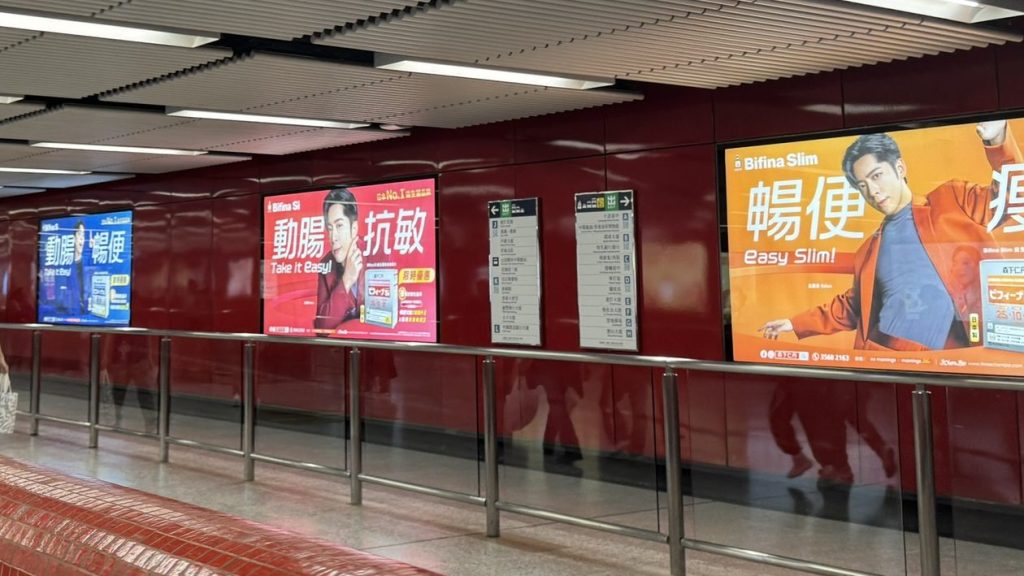
I daydreamed of finding my way back to an optimistic mindset; which mental escalators do I take?
I leave my “signage” in journals, but later I too often struggle to fully empathize with the words, and that’s when I do read them (which itself is an infrequent occurrence).
I wish I could inhabit an unshakable positive orientation toward the world.
At night, in all likelihood a response to these feelings, I picked up Epictetus again. I find it helpful to read philosophy or spiritual/religious texts when I am feeling cynical—or a consoling piece of fiction (Young Mungo, which I finished a few days ago, was not quite that—a hopeful outlook at the end (maybe), and some scattered life-affirming/consoling moments, but overall a bleak read).